Strategic Growth Journal | Issue 2: Financial Management & Profitability
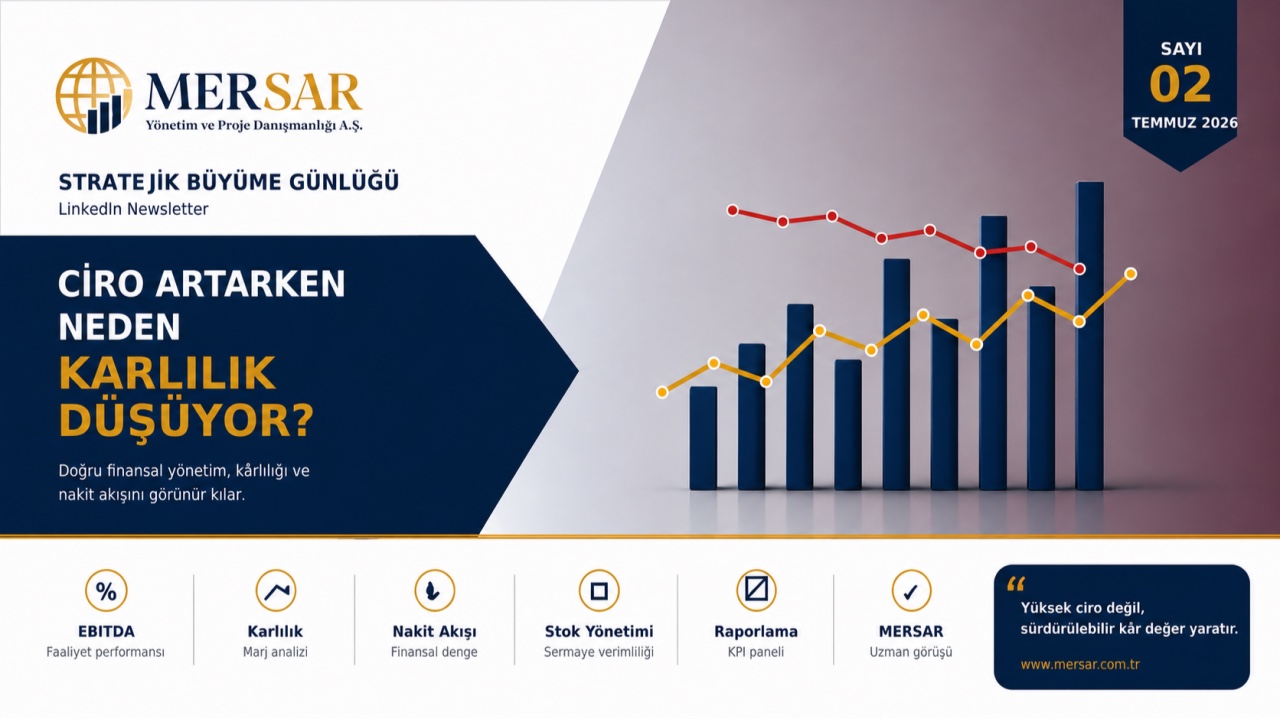
Executive Summary
Increasing sales does not always mean that a company’s financial performance is improving. An organization’s true ability to create value is measured by how effectively it converts revenue into profit, profit into cash, and cash into sustainable growth.
In this issue, we examine the key factors that weaken profitability despite strong revenue growth, focusing on EBITDA, cash flow, inventory management, financing costs, and management reporting.
Why does profitability decline while revenue is growing? Growth alone is not success. Sustainable profitability requires disciplined financial management.
Topics Covered in This Issue
- The relationship between revenue growth and financial performance
- The importance of EBITDA and operating profitability for management
- Key performance indicators for profitability analysis
- The role of cash flow compared with the balance sheet and income statement
- KPI-driven management reporting and decision-making
1. Revenue Growth Does Not Always Mean Success
An increase in sales volume is generally a positive indicator of market share expansion and commercial activity. However, revenue growth alone does not increase a company’s value. The critical question is how much profit these sales generate and how effectively that profit is converted into cash.
Some businesses increase their sales while sacrificing gross profit margins, facing higher financing costs, or losing control over operational expenses. As a result, the company works harder but creates less value.
Key takeaway: High revenue alone is not an indicator of success. What truly matters is the cost at which sales are generated, the profit they create, and how quickly those profits are converted into cash.
2. What Is EBITDA and Why Is It Important?
EBITDA (Earnings Before Interest, Taxes, Depreciation, and Amortization) measures a company’s operating profit before financing, taxation, and non-cash accounting expenses. It is one of the most important indicators of operational performance.
EBITDA removes the effects of financing structure, taxation, depreciation, and amortization, allowing management to evaluate the company’s core operating performance more accurately.
Low EBITDA despite strong revenue growth may indicate problems related to operational efficiency, pricing strategy, or cost management.
Why EBITDA Matters
- Enables meaningful comparisons of operational performance across different periods.
- Supports management decisions related to pricing, cost control, and operational efficiency.
- Provides investors and financial institutions with a clearer picture of the company’s operating strength.
3. How Should Profitability Be Analyzed?
A sound profitability analysis cannot rely solely on net profit. The income statement, balance sheet, and cash flow statement should be evaluated together. This integrated perspective reveals where the company is creating — or losing — value.
The underlying issue may stem from pricing strategy, production costs, operating expenses, inventory policies, collection periods, or financing costs. Therefore, management teams should monitor key performance indicators (KPIs) regularly and analyze any deviations together with their root causes.
| Indicator | What it measures | Management insight |
|---|---|---|
| EBITDA | Operating profitability | Measures the value created through core business operations. |
| Gross Profit Margin | Initial profit generated from sales | Reveals pricing pressure and cost structure challenges. |
| Cash Flow | Day-to-day financial health | Monitors liquidity, financing requirements, and collection risks. |
| Inventory Turnover | Capital efficiency | Indicates how long capital remains tied up in inventory. |
| Collection Period | Conversion of receivables into cash | Highlights delays in the cash cycle and potential credit risks. |
| Net Profit Margin | Overall profitability | Measures the value remaining after all operating and financing costs. |
4. Why Is Cash Flow a Critical Management Indicator?
A company may appear profitable from an accounting perspective while still experiencing cash shortages. The primary reason is the timing difference between accounting profit and actual cash generation.
While the income statement reflects financial performance, cash flow represents the company’s ability to sustain its daily operations.
Extended collection periods, excessive inventory investments, short-term debt pressure, and uncontrolled growth can significantly reduce financial flexibility. For this reason, especially during periods of rapid growth, cash flow should be monitored daily, weekly, and monthly.
Practical recommendation: Prepare at least a 13-week rolling cash flow forecast to identify collection, payment, financing, and inventory risks at an early stage.
5. How Should Management Reports Be Prepared?
Management reports should be more than financial tables prepared by the finance department. Effective reports should be clear, comparative, visually supported with charts, KPI-driven, and designed to facilitate decision-making.
Reports should include target-versus-actual comparisons, trend analyses, variance explanations, and recommended actions. This transforms management reports from historical summaries into forward-looking decision-making tools.
Action Plan for Management
| Priority | Action | Recommendation |
|---|---|---|
| 1 | Move beyond revenue as the sole objective. | Track sales targets together with gross profit and cash conversion performance. |
| 2 | Institutionalize pricing discipline. | Integrate discounts, payment terms, and cost increases into regular profitability analyses. |
| 3 | Prepare weekly cash flow forecasts. | Monitor collections, payments, inventory, and financing needs using a minimum 13-week rolling forecast. |
| 4 | Make management reporting decision-oriented. | Include target vs. actual results, variance analysis, and clearly assigned action owners in every report. |
MerSar Expert Insight
“Companies are not built on sales alone. Sustainable growth is achieved by organizations that successfully manage profitability, cash flow, and financial discipline together. Strong financial analysis is the foundation of long-term success.”
— Ayhan Coşar, Chairman of the Board
Conclusion
Financial success cannot be measured solely by the figures presented in the income statement. Sustainable growth requires organizations to control costs, improve operational efficiency, manage cash flow effectively, and continuously monitor key financial indicators.
High revenue creates real value only when it is supported by strong profitability and healthy cash flow. Therefore, financial management discipline should be considered a strategic management priority for every company seeking sustainable growth.
Call to Action
If you would like to objectively evaluate your company’s financial performance, strengthen your profitability analysis, and develop financial strategies that support sustainable growth, contact the experts at MerSar.