Strategic Growth Journal | Issue 3: Tax Planning Strategies
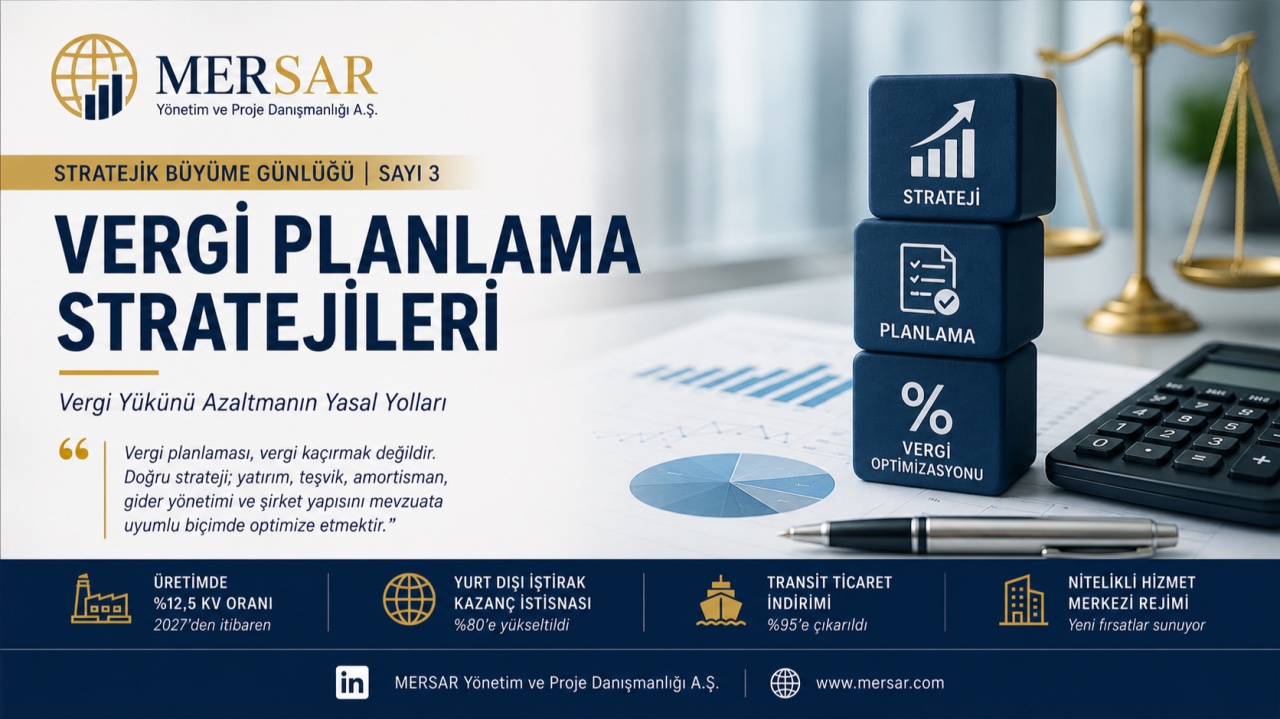
Legal Ways to Reduce Your Tax Burden
[01] Executive Summary & Strategic Framework
Tax planning is not just about paying less tax; it is about managing cash flow, investment capacity, and corporate sustainability.
The core message of this issue: Tax is not merely a liability calculated at year-end. It sits at the centre of many strategic decisions — from investment choices and financing structure to expense policy and corporate organization. Poor tax planning can weaken cash flow, create unnecessary costs and complicate growth decisions.
The significant changes in Turkish tax legislation as of 2026 — particularly the foreign subsidiary profit exemption, transit trade deduction, qualified service centre regime and corporate tax rates specific to production activities — present important new opportunities for companies.
Key Tax Metrics for 2026
| Rate | Scope |
|---|---|
| 12.5% | Production CIT rate |
| 80% | Foreign subsidiary exemption |
| 95% | Transit trade deduction |
| 100% | Service export deduction |
Strategic Context
Tax planning strategies created within legal boundaries contribute to more efficient use of company resources, increased investment power, and more robust progress toward sustainable growth targets. The regulations enacted in 2026 represent a significant turning point in Turkish tax legislation.
Companies with industrial registry certificates engaged in actual production will benefit from a 12.5% corporate income tax rate starting from 2027. For exporting manufacturers, the effective rate drops to approximately 9%. The foreign subsidiary profit exemption threshold has been reduced from 50% to 20% ownership, while the exemption rate increased from 50% to 80%.
[02] What is Tax Planning?
Organizing a company’s activities and financial decisions in compliance with existing tax legislation to optimize the tax burden within legal boundaries.
Scope of Planning
- Timing investments correctly
- Effectively utilizing incentives and supports
- Selecting appropriate depreciation methods
- Proper classification and documentation of expenses
- Transfer pricing compliance
- Foreign subsidiary and holding structuring
- Managing provisional tax periods with cash flow
Critical Impact for Management
- Managing tax payment schedule with cash flow
- Reading profitability projections more accurately
- Improving investment payback period
- Identifying risks in advance
- Optimizing equity cost
- Ensuring international tax compliance
- Increasing company value
[03] Most Common Tax Mistakes
These mistakes can be prevented with a professional approach, and company resources can be protected.
| # | Mistake | Why it matters | Risk |
|---|---|---|---|
| 1 | Leaving tax planning to year-end | Investment, expense, and financing decisions made throughout the year directly affect tax outcomes. A monthly calendar should be created. | High |
| 2 | Recognizing incentives and deductions too late | Conditions, documents, and deadlines for benefits must be tracked from the outset. The 2026 digital matching system makes errors more visible. | High |
| 3 | Misclassifying expenses | Expenses without business connection or missing documentation can create audit risk. Documentation under CIT Law Article 11 is critical. | Medium |
| 4 | Neglecting depreciation planning | The impact of asset investments on periodic profit and tax base must be analyzed in advance. Method selection is strategic. | Medium |
| 5 | Transfer pricing non-compliance | Transactions with related parties must be documented at arm’s length. Special irregularity penalties apply under CIT Law Article 13 and PIT Law Article 41. | High |
| 6 | Delaying foreign profit repatriation | Under CIT Law 5/1-b and PIT Law 22/4, foreign profits must be transferred to Turkey by the declaration deadline. Delay results in loss of exemption. | High |
| 7 | Ignoring minimum corporate tax | As of 2026, certain exemptions cannot be deducted from the minimum CIT base. This must be considered in planning. | Medium |
[04] Corporate Income Tax Rate Comparison
Understanding the new tax landscape for 2026 and beyond:
| Company profile | Corporate income tax rate |
|---|---|
| General CIT rate | 25% |
| Trading companies | 25% |
| Manufacturer (domestic) | 12.5% |
| Exporter (non-manufacturing) | 20% |
| Manufacturer + exporter | 9% |
| IFM participants | 0% |
Key Rate Changes
General CIT Rate (25%): Applies to all companies not qualifying for special rates or exemptions. This remains the baseline for trading companies and service providers.
Production Rate (12.5%): Starting from 2027, companies with industrial registry certificates engaged in actual production benefit from this reduced rate. Combined with export incentives, the effective rate can drop to 9%.
IFM Participants (0%): Istanbul Financial Center participants enjoy 100% CIT exemption extended until 2047, with financial activity fee exemptions for 20 years.
[05] Foreign Subsidiary Profit Exemption
Major changes to the participation exemption regime effective 2026:
| Criterion | Before 2026 | After 2026 |
|---|---|---|
| Minimum ownership threshold | 50% | 20% |
| Exemption rate | 50% | 80% |
Minimum Ownership Threshold: Reduced from 50% to 20% of paid-in capital. This significantly expands the pool of qualifying investments and makes the exemption accessible to more companies with minority stakes in foreign subsidiaries.
Exemption Rate: Increased from 50% to 80% of foreign subsidiary profits. Combined with the lower ownership threshold, this represents a substantial enhancement of the incentive for international expansion.
Transfer Requirement: Profits must be transferred to Turkey by the declaration deadline. No tax burden condition applies (unlike previous versions), but timely repatriation is critical to maintain the exemption.
CPA Attestation: For exemptions exceeding 500,000 TRY, a Certified Public Accountant attestation report is mandatory. This adds a compliance layer but provides additional assurance.
[06] Foreign Holding Structures & Tax Advantages
International corporate structuring and the strategic role of holding centers:
Netherlands Holding Model
The Netherlands is one of the most popular holding centers for Turkish investors. Under the Turkey-Netherlands DTA, special advantages are provided for dividend transfers from Dutch holding companies to Turkish parent companies. The participation exemption regime allows foreign subsidiary profits to be exempt from tax in the Netherlands. However, these advantages must be reassessed after the MLI (Multilateral Instrument) process.
Luxembourg Holding Model
Luxembourg offers tax deductions on income from industrial property rights through its IP box regime. When combined with the industrial property rights sale profit exemption under CIT Law 5/B, an attractive structure can be created for technology-focused companies. Luxembourg’s extensive DTA network and EU membership provide additional advantages.
UK / Estonia Models
Holding companies established in the UK offer a reliable structure with a wide DTA network and stable legal framework. Estonia attracts attention with its deferred taxation model, where company profits are not taxed until distributed. This model allows investment decisions to be deferred without tax burden.
[07] Tax-Efficient Dividend Route
Sample scenario for optimizing international profit repatriation:
Step 1 – Germany Subsidiary: Profits generated in Germany are subject to local CIT at 15-25%, depending on the federal state and municipal trade tax.
Step 2 – Netherlands Holding: Dividends flow to the Netherlands holding company. Under the participation exemption, these dividends are generally exempt from Dutch CIT, provided the ownership conditions are met.
Step 3 – Turkish Parent: The Turkish parent company receives dividends from the Netherlands holding. Under CIT Law 5/1-b, 80% of these profits are exempt from Turkish CIT (with the new 2026 rates).
Effective Result: The combined tax burden across all jurisdictions can be reduced to approximately 5% effective CIT rate, compared to 25% if all profits were directly taxed in Turkey.
[08] Transfer Pricing & Compliance
Arm’s length compliance and documentation obligations for related party transactions:
Legal Framework
Under CIT Law Article 13 and PIT Law Article 41, the arm’s length principle is mandatory for transactions between related parties including goods and services sales, borrowing, leasing, licensing, and management services. Failure to comply results in tax evasion penalties and special irregularity penalties.
Transactional Net Margin Method (TNMM)
The most commonly used transfer pricing method in Turkey. Sales to related parties are compared with profit margins achieved in similar independent transactions. Database usage (Amadeus, Orbis) for comparable analysis has become standard.
Documentation Obligation
Annual transfer pricing report (Local File), group-level report (Master File), and country-by-country report (CbCR) may need to be prepared. CbCR obligation applies particularly to groups with consolidated turnover exceeding 750 million TRY. Incomplete reports trigger special irregularity penalties.
Advance Pricing Agreement (APA)
Through an Advance Pricing Agreement with the Revenue Administration, acceptable pricing methods for related party transactions in future periods can be predetermined. This significantly reduces tax audit risk and provides predictability for the business.
[09] 2026 Critical Tax Updates Timeline
Important regulations enacted through Law No. 7582 and Presidential Decree No. 11257:
April 30, 2026 — Presidential Decree 11257
Foreign subsidiary profit exemption ownership threshold reduced from 50% to 20%, exemption rate increased from 50% to 80%. Service export deduction increased from 80% to 100%. PIT foreign profit share exemption ownership threshold reduced from 50% to 20%.
June 4, 2026 — Law No. 7582 Enacted
12.5% CIT rate for production and agricultural production profits. Transit trade profit deduction at 95% (100% for IFM). Qualified service center regime introduced. 20-year income tax exemption for foreign income. Asset peace regulation (until July 31, 2027).
July 1, 2026 — Declaration Period Begins
New regulations reflected in declaration periods. First declarations for transit trade and qualified service center deductions submitted. CPA attestation report requirement (for exemptions over 500,000 TRY) applied.
2027 — Production Deduction Active
12.5% CIT rate for companies with industrial registry certificates engaged in actual production to begin applying. For exporting manufacturers, the effective rate drops to 9%. This regulation applies to 2027 and subsequent years, not 2026 profits.
[10] Other Tax Types & Incentives
Value Added Tax (VAT)
Export transactions are VAT exempt. Export-registered deliveries benefit from deferral-waiver. VAT refund related to exports (in cash or by offset). In 2026, cash refund up to 200,000 TRY without CPA report, up to 2,000,000 TRY with CPA report. Investment incentive certificates provide VAT exemption for machinery imports and domestic purchases.
Stamp Duty
Documents related to salaries of personnel in qualified service centers are exempt from stamp duty. Income tax exemption up to 4 times gross minimum wage (6 times for IFM) applies. Free zone transactions and certain donations are also exempt.
Withholding Tax
Minimum wage income tax and stamp duty exemption continues for all employees. R&D personnel in technoparks and R&D centers benefit from withholding tax incentives. Additional incentives for doctoral and master’s degree personnel. Disabled employees receive additional exemptions.
Special Consumption Tax (SCT)
Exported goods are exempt from SCT. Free zone deliveries and investment incentive certificate imports benefit from SCT exemptions. Renewable energy investments and environmentally friendly vehicles receive SCT deductions. Electric vehicle imports enjoy SCT advantages.
[11] Implementation Checklist
Annual Planning
- Tax planning tracked throughout the year
- Incentive analysis before investment decisions
- R&D, production and export advantages reviewed
- Depreciation plan aligned with strategy
- Inter-group transactions compliant
- Transfer pricing report prepared
- CPA attestation requirements tracked
Periodic Operations
- Expenses properly classified and documented
- Provisional tax managed with cash flow
- Corporate structure aligned with growth
- Foreign profit repatriation disciplined
- VAT refund processes tracked
- SCT exemptions evaluated
- Personnel incentives optimized
MerSar Expert Insight
“Tax planning should not be seen merely as a financial obligation. A well-structured tax strategy increases a company’s investment capacity, protects cash flow and supports long-term growth targets. What matters is making conscious use of the rights the law provides while remaining in full compliance with legislation.”
— Ayhan Coşar, Chairman of the Board, MerSar
Conclusion
Tax planning is not a one-time calculation made at year-end. Effective tax management must be considered together with investment, financing, expense management, incentive utilization, R&D strategy, transfer pricing, international corporate structuring, and tax compliance.
The regulations that came into force in 2026 — the 20% ownership threshold and 80% exemption rate for foreign subsidiary profit exemption, 95-100% deduction for transit trade and service exports, 12.5% corporate tax rate for production activities, qualified service center regime, and extension of IFM incentives to 2047 — offer significant opportunities for companies.
Proper planning within legal boundaries contributes to companies using their resources more efficiently, strengthening cash flow, and making more robust progress toward sustainable growth targets. However, tax planning is a process that requires professional advisory, detailed analysis, and disciplined implementation.
Call to Action
To manage your company’s tax burden more effectively within legal boundaries, properly evaluate investment and incentive advantages, and receive professional support on international tax structuring and transfer pricing, contact MerSar.